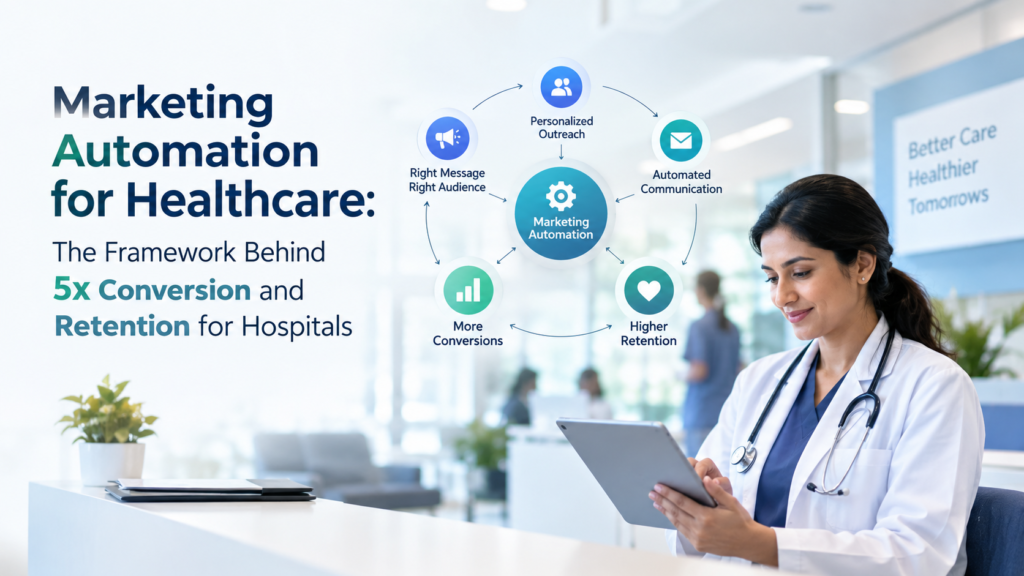

The Framework Behind 5x Conversion and Retention for Hospitals
A patient fills your “Book a Consultation” form at 11:40 pm. She’s anxious and she’s comparing three hospitals on her phone. Your front desk calls her back at 10:15 the next morning. By then she has already booked with the hospital that sent her a WhatsApp confirmation within two minutes.
That hospital didn’t have better doctors or a bigger ad budget. It had a system that answered while everyone was asleep.
This is the part of healthcare marketing nobody puts in the pitch deck. Hospitals, clinics and diagnostic labs spend lakhs, dirhams or dollars getting the phone to ring. Then they lose a painful share of those patients in the gap between “enquiry received” and “appointment attended.”
We’ve implemented the framework in this article with a couple of hospitals. After it went live, they saw 5x growth in conversion and retention: more enquiries turned into attended patients, and more of those patients came back. None of it depended on a clever ad or a bigger budget. It came from closing the gaps that were already leaking patients, both before the first visit and after it.
Most healthcare marketing problems are follow-up problems
When a hospital marketing head tells us “we need more leads,” we ask for three numbers:
- How many enquiries came in last month?
- How many were contacted within an hour?
- How many turned into a patient who actually walked in?
Almost nobody has all three. The ones who do usually find that the leak sits after the lead, not before it. Common causes include:
- Calls that went to a busy reception line
- Form fills that sat in an inbox until Monday
- Patients who booked but never showed up
- Patients who finished treatment and were never contacted again
Buying more traffic into a leaking bucket is the most expensive growth strategy in healthcare. Marketing automation, done properly, patches the bucket first.
What marketing automation actually means in healthcare
Most people hear “marketing automation” and think of monthly newsletters or a drip email sequence about “10 tips for a healthy heart.” That’s the least valuable part.
In a hospital or clinic, automation is about six moments in the patient’s path where a human team reliably drops the ball:
- The first response. Someone enquires and gets an instant, useful reply on the channel they actually use.
- Routing. The enquiry reaches the right department, doctor or counsellor, not a generic inbox.
- Booking. The patient picks a slot without three rounds of phone tag.
- Showing up. Reminders, directions, prep instructions and a one-tap reschedule option go out automatically.
- Recovery. Missed calls, no-shows and “I’ll think about it” enquiries get a structured follow-up instead of being forgotten.
- Return. Follow-up consultations, repeat tests, recall visits, reviews and referrals happen by design.
If your automation covers moments one and four well, you’ll feel the difference within a month. If it covers all six, that’s where compounding growth comes from.
The framework we used with hospitals: the Patient Loop
Steps one to four are what drove the conversion side of the 5x. Steps five and six drove retention. Hospitals that stop after step four get a good first month. Hospitals that finish the loop keep growing.
This is the exact structure we implement. It’s deliberately boring to describe. The results come from doing every step, not from any single trick.
1. Capture everything in one place. Every enquiry source lands in a single CRM with its source tagged. That includes Meta and Google lead forms, website forms, WhatsApp clicks, missed calls on the IVR, Practo or listing enquiries, and walk-ins entered by reception. If a lead lives in someone’s personal WhatsApp or a notebook, it doesn’t exist.
2. Respond within minutes, day or night. Every new enquiry triggers an instant message on WhatsApp in India and the UAE, or SMS in the US. The message confirms who they reached, what happens next, and a booking link. A task goes to the right team member at the same time. The 11:40 pm patient gets an answer at 11:41.
3. Qualify and route. A few short questions work better than a long form: department, preferred location, preferred time, and insurance or cash. Then the lead routes itself. Cardiology enquiries go to the cardiology coordinator, IVF enquiries go to a counsellor, and international patients go to the international desk.
4. Book and remind. Online slot booking connects to the doctor’s calendar. Then reminders go out 24 hours and two hours before, with the address, a map link, parking notes, fasting or prep instructions for diagnostics, and a reschedule button. Reschedule is the most underrated button in healthcare. A rescheduled patient is revenue saved. A no-show is revenue gone.
5. Recover the ones you’d normally lose. Missed call? An automatic “Sorry we missed you” text goes out with a booking link. No-show? A same-day check-in message. Enquired but didn’t book? A short, respectful nurture sequence over seven to ten days that answers their likely doubts: cost, recovery time, which doctor. We stop the moment they book or opt out.
6. Bring them back. A post-visit feedback message goes out, and a Google review request goes only to satisfied patients. Recall reminders cover follow-up consultations, annual health checks, dental cleanings and repeat diagnostics. Referral prompts go to happy patients. This is where lifetime value lives, and most hospitals leave it untouched.
Every step feeds a dashboard with a few numbers: enquiries by source, time to first response, booking rate, show rate, and revenue by campaign. Once a marketing head can see cost per attended patient instead of cost per lead, budget conversations with management change completely.
Why we default to GoHighLevel for most clinics and hospital chains
We get asked about every tool in the market: HubSpot marketing automation, Salesforce marketing automation, Zoho marketing automation, ActiveCampaign, Mailchimp automation, Braze, Oracle Eloqua and SharpSpring. They’re all capable. For most healthcare businesses, though, they’re either too expensive, too generic, or built for a different buyer.
For clinics, diagnostic labs, dental, IVF and aesthetic practices, and small-to-mid hospital chains, our default is HighLevel (GoHighLevel). The reasons are practical:
- It’s a CRM with email automation, SMS automation, WhatsApp, calendars, forms, funnels and pipelines in one place. You’re not stitching five tools together and paying for five subscriptions.
- Booking is built in. Appointment calendars with round-robin across doctors or counsellors, automatic confirmations and reminders work without extra software.
- Missed-call text-back and two-way messaging come as standard. For a busy reception desk, that feature alone recovers patients every week.
- Pipelines map naturally to patient stages: Enquiry, Contacted, Booked, Attended, Treatment Plan, Completed and Recall.
- Reputation management pushes review requests after visits, which matters for local search.
- The cost stays sane as you grow. Adding locations or users doesn’t multiply your bill the way per-contact or per-seat platforms do.
It also has trade-offs. HighLevel isn’t a hospital information system (HIS) and shouldn’t hold clinical records. Its reporting is good for marketing but not enterprise business intelligence. For US practices, you must confirm your plan supports HIPAA requirements and that a Business Associate Agreement is in place before any patient data flows in.
So when would we recommend something else?
- HubSpot fits healthtech startups selling B2B to hospitals or insurers. There you need content marketing, lead scoring and sales pipelines more than appointment reminders.
- Salesforce Health Cloud and Marketing Cloud fit large hospital groups with an IT team and a real integration budget, where the CRM must talk to the HIS, billing and call centre at enterprise scale.
- Zoho fits cost-conscious Indian organisations already running Zoho for finance or HR and who want to stay in one ecosystem.
- Braze fits consumer health apps with high-volume in-app and push engagement, not hospitals.
- Mailchimp, ActiveCampaign, Constant Contact and GetResponse are fine for newsletters. They’re weak for a healthcare business whose patients live on WhatsApp and phone calls.
The best marketing automation platform is the one your front desk will actually use on a Tuesday afternoon. Software that the marketing team loves and reception ignores produces zero patients.
India, the US and the UAE need different channel mixes
The same framework works in all three markets. The channel mix doesn’t.
India. WhatsApp is the first channel, not an add-on. Patients expect to confirm, reschedule and ask questions there. Use the official WhatsApp Business API with approved templates, not a personal number or a grey-market bulk sender. Hindi and regional-language templates noticeably improve responses outside metro English audiences. Calls still matter, so missed-call automation is essential.
UAE. WhatsApp also dominates here, with bilingual Arabic and English messaging. Aesthetic, dental and wellness clinics compete hard on speed and service, so instant response and reminders are table stakes. The audience also includes many expats, which means follow-up timing needs care around travel and time zones.
US. SMS and email carry most of the load, alongside patient portals. SMS needs explicit consent and clean opt-out handling. Email reminders and recall campaigns still perform because patients check email for appointments and bills.
Compliance decides what you can automate
Healthcare is the one industry where a “growth hack” can become a legal problem. Before you automate anything, work through the basics for your market:
- India: The Digital Personal Data Protection Act, 2023 requires clear consent and purpose for personal data. Medical professional conduct rules also limit how individual doctors can promote themselves. Promote the facility, services and patient education. Don’t make outcome guarantees.
- US: HIPAA governs protected health information. Your CRM and messaging vendors need signed BAAs. Keep diagnosis details out of SMS and email bodies, and follow consent rules for texting.
- UAE: Federal health data rules apply, and emirate health authorities (DHA in Dubai, DOH in Abu Dhabi) regulate medical advertising content. Some ad content needs approval.
Our operating rules in every market: collect consent at the point of enquiry, keep messages logistical rather than clinical (“Your appointment is confirmed,” not “Your fertility test results are ready”), honour opt-outs instantly, and keep clinical data in the HIS rather than the marketing CRM.
What the setup looks like by business type
- Single clinic or specialist practice: Instant response, online booking, reminders and review requests. This is the fastest ROI in healthcare marketing, often live within two weeks.
- Dental, IVF and aesthetic clinics: These are high-consideration, high-ticket decisions. The nurture sequence matters most here. Patients research for weeks, so follow-up that answers cost, process and doctor questions wins the booking.
- Diagnostic labs: Prep instructions, home-collection slot booking, report-ready notifications that avoid clinical details, and repeat-test recall (thyroid, diabetes panels, annual checks).
- Hospital chains: Centralised capture with location-based routing, department pipelines, a call-centre view, and source-to-revenue reporting across branches.
- Healthtech startups: Usually B2B. Account-based outreach to hospitals, demo booking and lead scoring, which is where HubSpot often fits better.
Mistakes we see over and over
- Automating before cleaning the data. Duplicate patients, missing phone numbers and untagged sources make every automation misfire.
- Too many messages. Patients are anxious, not shopping for shoes. Three thoughtful follow-ups beat ten generic ones.
- No human handoff. Automation should get a qualified patient to a person faster, not replace the person.
- Measuring leads instead of attended patients. A campaign with cheap leads and poor show rates is a bad campaign.
- Buying enterprise software for a 3-clinic chain. You’ll pay for features nobody configures.
Where to start this month
You don’t need all six stages on day one. Start in this order:
- Get every enquiry source into one CRM.
- Turn on instant response and missed-call text-back.
- Add booking reminders with a reschedule option.
- Measure time to first response and show rate for 30 days.
Those four steps alone usually expose where your patients are going. Then build recovery and recall on top.
At Opsiko, this is the work we do: marketing operations for healthcare, built on HighLevel, WhatsApp and the CRM stack that suits your size, set up in line with the rules of your market. If you run marketing for a hospital, clinic, diagnostic lab or healthtech company in India, the US or the UAE, we’ll audit your current enquiry-to-appointment flow and show you exactly where patients are leaking.
Frequently asked questions
What is marketing automation for healthcare?
It’s the use of software to automatically respond to patient enquiries, route them to the right team, book and remind appointments, follow up with missed or undecided patients, and bring patients back for follow-ups and recall visits, all while following data and consent rules.
Is GoHighLevel HIPAA compliant?
HighLevel offers HIPAA-related support, but US practices must confirm their specific plan covers it and sign a Business Associate Agreement before storing patient data. Outside the US, check local data protection laws such as India’s DPDP Act.
Which is better for hospitals: HubSpot, Salesforce, Zoho or GoHighLevel?
For clinics and small-to-mid chains focused on appointments, GoHighLevel usually offers the best value. Large hospital groups with integration needs lean toward Salesforce. Healthtech B2B companies often fit HubSpot. Zoho suits teams already on the Zoho ecosystem.
How long does it take to see results?
Instant response and reminders typically show impact within the first month. The recovery and recall stages compound over three to six months.
Keep reading this article
Enter your email and mobile number to unlock the full post. You only need to do this once.