
a practical framework for CRM, WhatsApp, SMS, email, lead follow-up and retention across markets.
At 10:14 a.m. on a Monday, a prospect fills out a loan enquiry form. The lead lands in the CRM. The sales team is busy. Nobody calls for two hours. By the time the first follow-up happens, the prospect has already spoken to another lender.
The competitor did not necessarily spend more on Google, Meta or lead generation. They simply had a system that responded immediately, asked the next useful question, routed the lead to the right person and kept following up when the first call was missed.
That gap between enquiry received and customer converted is where many fintech and BFSI businesses lose money. The ad gets the attention. The landing page captures the lead. But the operating system after the lead arrives is often manual, fragmented or too slow.
We see this pattern repeatedly. For healthcare clients, we have worked with a couple of hospitals that saw 5x growth in conversion and retention after implementing our frameworks. In fintech and BFSI, the same principle applies without relying on a headline number: better routing, faster follow-up, relevant nurturing and clear lifecycle reporting create a much stronger path from enquiry to customer.
Most fintech marketing automation problems are follow-up system problems
Before changing platforms, we ask for three numbers. They tell us whether the real issue is acquisition, operations or conversion.
- How many leads become a meaningful sales conversation? Not just a submitted form, but an actual connected conversation or qualified interaction.
- How quickly does the first human or automated response happen? Break this down by source, product and team if possible.
- How many leads reach the final business outcome? Track applications, funded accounts, issued policies, activated users or another agreed conversion event.
The usual leaks are familiar:
- Leads sit in a shared inbox or spreadsheet instead of being assigned automatically.
- Follow-up depends on individual salespeople remembering when to call or message.
- WhatsApp, SMS and email operate as separate campaigns rather than one customer journey.
- High-intent leads receive the same nurturing as low-intent enquiries.
- Marketing reports leads and CPL while sales reports conversions, leaving nobody accountable for the full journey.
The expensive part is not generating the lead. It is letting a paid lead become an unmanaged lead.
What marketing automation for fintech actually means in BFSI
The shallow definition is sending automatic emails. For BFSI, it means designing the operational journey that moves a prospect from interest to application, activation, repeat usage and retention.
- The first response. A new enquiry should trigger an immediate acknowledgement, capture the source and product interest, and create the appropriate sales task.
- The qualification moment. The CRM should collect useful fields such as product, location, intent, eligibility stage and preferred contact channel instead of forcing salespeople to rediscover the same information.
- The missed-call moment. If a salesperson cannot connect, the system should automatically move the lead into an appropriate callback and nurture sequence.
- The application drop-off. If someone starts an application but does not complete it, the workflow should identify the stage and trigger a relevant reminder rather than a generic promotional message.
- The approval or onboarding moment. Once the customer crosses a key stage, communication should change from acquisition messaging to onboarding, education and next-action messaging.
- The retention moment. Product usage, renewal dates, inactivity or customer milestones should trigger lifecycle communication before the relationship goes cold.
The quickest wins usually come from response time, lead routing and missed-follow-up automation. Compounding growth comes from application recovery, onboarding and retention journeys that continue working after the original campaign ends.
The Fintech Customer Loop
We call our operating model the Fintech Customer Loop. Conversion steps move prospects toward a business outcome. Retention steps keep customers active and create the next useful interaction.
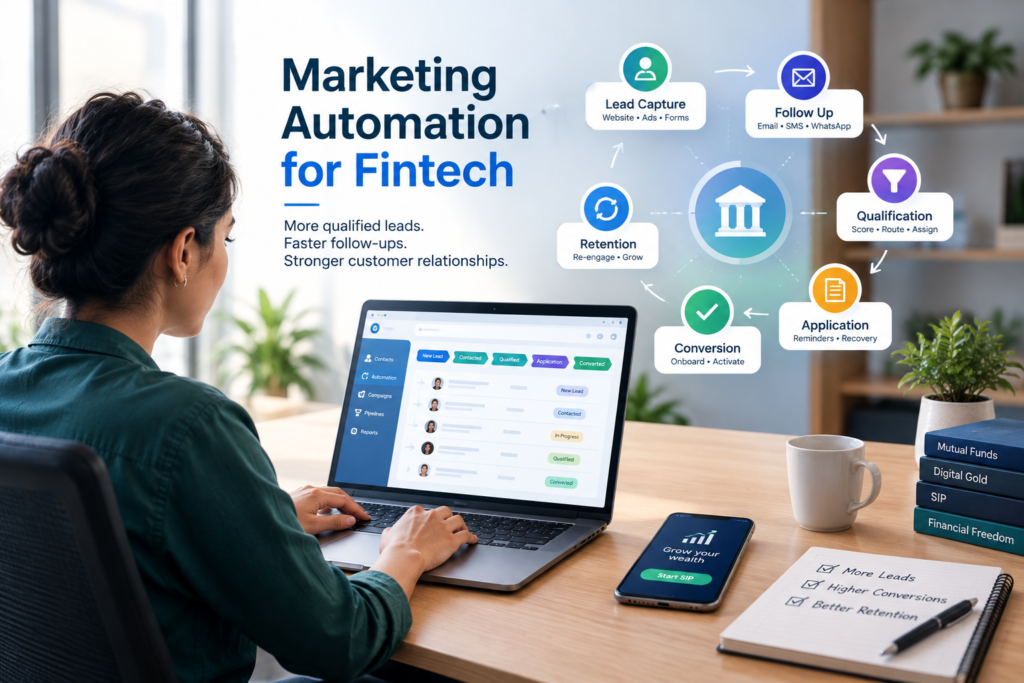
1. Capture and enrich. Every lead should enter one CRM record with source, campaign, product interest, geography, consent status and lifecycle stage. Forms, landing pages, WhatsApp conversations and inbound calls should map into the same customer record where technically appropriate. We also add UTM data so the eventual customer can be traced back to the campaign that created the enquiry.
2. Route by intent. Not every lead deserves the same workflow. A high-intent application enquiry can create an immediate sales task and a short response window, while an educational content lead can enter a longer fintech lead nurturing sequence. Routing can use product, geography, lead score, working hours and assigned team. The owner should be visible in the CRM rather than hidden in an operations spreadsheet.
3. Respond across the right channels. The first confirmation can happen immediately through the permitted channel, followed by WhatsApp automation, SMS automation or email depending on consent, customer preference and market rules. The message should confirm the next step rather than overwhelm the prospect with product information. If a human response is required, the CRM should create a task with the relevant context.
4. Recover stalled journeys. A missed call, incomplete form, abandoned application or unanswered message should change the workflow. For example, a lead that does not connect after the first sales attempt can receive a controlled reminder, followed by another task and then a lower-frequency nurture sequence. The workflow should also stop when the lead converts, opts out or becomes ineligible.
5. Activate and educate. Once the customer converts, the workflow should not keep treating them like a prospect. Trigger onboarding messages, document reminders, product education, account activation guidance and service communications based on the actual lifecycle stage. This is where customer lifecycle automation becomes useful beyond acquisition.
6. Measure the loop. Our dashboard typically connects lead source, response time, contact rate, qualified rate, conversion, revenue or funded outcome and retention indicators. That changes the budget conversation because marketing can discuss business outcomes instead of stopping at impressions, clicks and CPL.
The point is not to automate every message. It is to make the important customer transitions visible, repeatable and measurable.
Why we default to GoHighLevel for small-to-mid fintech businesses
For many small and mid-sized businesses, we compare GoHighLevel with HubSpot, Salesforce, Zoho CRM and other financial services CRM options. Our default for the right segment is GoHighLevel, particularly when the business needs CRM, workflows, landing pages, messaging and reporting in one operating environment without building a large enterprise stack.
- Fast workflow deployment. We can build lead routing, pipeline stages, follow-up sequences and internal tasks without a long custom-development cycle.
- Multiple channels in one operating model. Email, SMS, calls and integrations can be connected to CRM stages instead of being managed as isolated campaigns.
- Useful for small teams. A founder or marketing head can see pipeline movement and follow-up status without requiring a large RevOps team.
- Strong campaign-to-CRM connection. Landing pages, forms and campaign tracking can feed directly into the operational journey.
- Flexible automation. Triggers can be based on forms, pipeline stages, tags, appointments, responses and other customer actions.
- Practical reporting. We can build reporting around operational stages instead of only channel-level marketing metrics.
The trade-off is straightforward. GoHighLevel is not the right answer for every regulated financial institution or complex enterprise. Deep core-banking integration, sophisticated data governance, large-scale permissions, highly complex product structures and enterprise compliance requirements may require a more specialized stack. WhatsApp, SMS and email also require separate checks around consent, templates, data processing, retention and vendor responsibilities. A platform cannot make a workflow compliant by itself.
When we’d recommend something else:
- Salesforce: when a larger financial institution already has a mature enterprise CRM and extensive internal integrations.
- HubSpot: when the main requirement is sophisticated B2B marketing and sales operations with a broader enterprise ecosystem.
- Zoho CRM: when a cost-conscious business wants a broad business software ecosystem and CRM is central to the wider stack.
- Specialized BFSI platforms: when core financial workflows, complex product administration or institution-specific governance requirements dominate the project.
Our view is simple: choose the smallest stack that can reliably run the customer journey you actually need, not the largest stack your business could theoretically buy.
India, the US and the UAE need different approaches
India: WhatsApp, SMS, phone calls and digital forms can all be important parts of the journey, while English and regional-language communication may need to coexist. Customers often move between digital research and human sales or support, so routing and consent records matter. For commercial communications, TRAI’s framework includes sender registration, headers, content templates and consent processes for applicable communications.
US: Email, SMS, phone and web forms are common parts of fintech acquisition and lifecycle programs. Consent and opt-out handling need to be designed into the workflow rather than added later. The FCC states that the TCPA applies to text messages as well as voice calls, while commercial email is governed by CAN-SPAM requirements including identification and opt-out mechanisms.
UAE: English and Arabic are important considerations, and customer communication can involve WhatsApp, phone, email and digital applications. Financial institutions also operate under detailed consumer-protection expectations around disclosure, advertising, consent and responsible conduct. CBUAE standards require direct marketing communications to follow applicable laws and expressed consumer consent and preferences.
Compliance decides what you can automate
- India: The Digital Personal Data Protection Act, 2023 establishes requirements around personal-data processing and consent, while TRAI’s TCCCPR framework governs applicable commercial communications and consent mechanisms.
- US: The TCPA and FCC rules are relevant to covered calls and texts, while CAN-SPAM applies to commercial email. Requirements vary by communication type and circumstances.
- UAE: Applicable requirements can include UAE federal telemarketing rules and, for licensed financial institutions, Central Bank of the UAE consumer-protection and telemarketing requirements.
Our operating rule is to build consent and suppression logic into the workflow from the beginning. We store the relevant consent status, source and timestamp where appropriate, separate transactional and promotional communication where required, stop sequences when a customer opts out or changes stage, and review message content before activation. We never treat the CRM platform as the compliance authority. Businesses should confirm current requirements with their legal, compliance or regulatory advisor and their messaging vendors before launch.
What the setup looks like by business type
- Digital lenders: Build lead capture, eligibility routing, application recovery and sales follow-up first because lost applications are difficult to recover manually.
- Insurance businesses: Start with enquiry qualification, advisor assignment, quote follow-up and renewal reminders because the customer journey often extends well beyond the first enquiry.
- Wealth and investment platforms: Build consent-aware lead nurturing, advisor routing and onboarding journeys first, with careful controls around product claims and promotional content.
- Fintech apps: Build activation and lifecycle automation alongside acquisition so an installed app does not become an inactive user.
- Banks and larger BFSI teams: Start with CRM-to-core-system integration, governance, consent and reporting architecture before adding large numbers of automated journeys.
Mistakes we see over and over
- Automating before mapping the journey: Teams create dozens of workflows that do not correspond to actual customer stages.
- Sending the same message to everyone: High-intent applicants, new leads, existing customers and inactive users receive irrelevant communication.
- Ignoring the sales handoff: Marketing automation generates leads but fails to create clear tasks, ownership and escalation rules for sales.
- Measuring only CPL: Cheap leads can look successful while producing weak application, activation or revenue outcomes.
- Building compliance later: Retrofitting consent, suppression and audit logic after campaigns are live creates unnecessary operational and legal risk.
Where to start this month
- Map the current journey. Take one product and document every step from ad click or enquiry through qualification, sales contact, application, conversion and retention.
- Find the largest operational leak. Measure response time, contact rate, stalled applications and conversion by source before deciding what to automate.
- Build the first workflow. Start with one high-value journey covering capture, routing, immediate acknowledgement, sales task creation and controlled follow-up.
- Connect the dashboard. Report the movement from lead to qualified conversation to business outcome so marketing and sales work from the same numbers.
Next, build the recovery and retention layer: missed-call sequences, abandoned-application journeys, onboarding, reactivation and renewal or repeat-purchase workflows.
At Opsiko, we design and implement CRM, marketing automation, WhatsApp, SMS, email workflows and reporting for healthcare and fintech businesses across India, the US and the UAE. We typically use GoHighLevel for small-to-mid businesses when it fits the operational requirement, while recommending a different stack when the complexity demands it. If your fintech or BFSI team is already generating enquiries but losing them between the CRM, sales team and customer lifecycle, we can audit the current flow and identify where the handoffs, triggers and follow-ups are breaking.
Frequently asked questions
What is marketing automation for fintech?
Marketing automation for fintech is the use of CRM workflows, messaging, lead routing and lifecycle triggers to move prospects and customers through defined stages. It can cover lead capture, qualification, follow-up, application recovery, onboarding, reactivation and retention.
Is GoHighLevel suitable for fintech businesses?
It can be suitable for small-to-mid fintech businesses that need practical CRM and automation without a large enterprise implementation. It should still be assessed against the business’s data, integration, messaging, security and compliance requirements before deployment.
Which is better: GoHighLevel vs HubSpot for fintech?
There is no universal winner. GoHighLevel can fit teams prioritising rapid CRM and multi-channel workflow deployment, while HubSpot can fit organisations that need a broader marketing and sales ecosystem. The right choice depends on integrations, team size, reporting, governance and the complexity of the customer journey.
Can WhatsApp and SMS follow-ups be automated for financial services?
Yes, but the workflow must account for applicable consent, opt-out, template, content and regulatory requirements in the relevant market. Automation should also stop or change when a customer converts, opts out or enters a different lifecycle stage. Confirm the current requirements with your compliance advisor and messaging provider before launch.
Keep reading this article
Enter your email and mobile number to unlock the full post. You only need to do this once.